New builds: how to prepare a garage for chargers
A garage is ready for chargers when a cable route with a junction box reaches every space and the sub-panel has load management and room for new chargers with MID-certified meters. The owner of each space can then order a charger whenever they need one, with no new work across the garage.

The planning document sets the minimum number of charging spots
The 2023 amendments to the Law on Planning and Construction (Official Gazette of RS 62/2023) introduced the terms “charging spot” and “charger.” Under Art. 31, para. 1, item 7, a planning document must contain “the number of garage or parking spaces, with a mandatory minimum number of charging spots.”
The law doesn’t set a number or a percentage. The exact figure is in the planning document and the location conditions for your lot, so check it at the start of design. What a developer gets in the offer is described on the page about chargers for new builds.
In the EU, the 2024 Energy Performance of Buildings Directive (EPBD) already applies. For new residential buildings with more than three parking spaces, it requires pre-cabling for at least 50% of the spaces. Serbia has not transposed this directive into its regulations (Energy Community, November 2025), so here it serves only as a benchmark, not an obligation.
What a prepared space includes
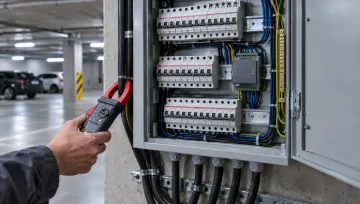
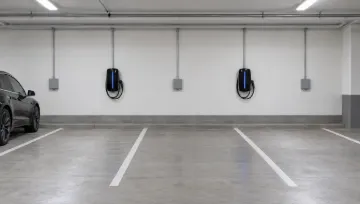
A prepared space is a parking space where a charger can be added later with a basic installation, without new work across the garage. Basic installation means the charger next to the junction box: up to 2 m of cable from the box to the charger, RCD protection and a breaker. Preparation has five parts:
- a cable route from the distribution board to the garage and a cable tray along the spaces;
- a junction box at each space, from which the charger’s basic installation starts;
- a sub-panel with surge protection, a main switch and spare room for new chargers;
- load management, which distributes the available power among the chargers in use at any given moment;
- a MID meter with every charger, so each space’s consumption is measured and billed separately.
Thanks to load management, the building’s grid connection doesn’t have to be sized as if all the chargers ran at full power at the same time. Based on EU practice, the cable route and sub-panel are sized at about 11 kW for the first space and about 4 kW for each additional one, as an upper guideline. The calculation for garages with 10, 20 or 50 spaces is in the guide on how much power a garage needs for chargers.
Preparation costs least while the building is going up
During construction, the cable route, tray and junction boxes go in together with the garage’s other installations. After residents move in, the same job is both more expensive and slower. The work is done in a garage full of parked cars, and work in the building’s common areas requires a decision by the residents’ assembly.
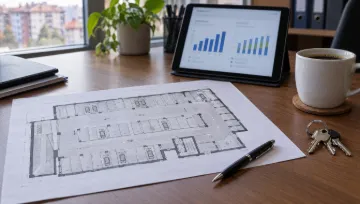
That’s why preparation should be part of the electrical design, before work in the garage begins. The sub-panel and cable route are then planned for all spaces, not just the first-phase chargers.
The planning document sets the minimum number of charging spots, but the owner of any space may ask for a charger later. About 7.200 electric cars are registered in Serbia (Ministry of Interior, April 2026). Sales of new ones in the first half of 2026 were more than three times higher than a year earlier (Auto-moto revija, July 2026).
So the examples below include preparation for every space in the garage, but chargers only for the first phase. Once the cable route and junction box are in place, each additional charger is a basic one-day installation.
What a prepared space costs
The price per prepared space is the shared part divided by the number of spaces in the garage. The shared part covers the cable route, the sub-panel with load management, preparation of all spaces, the design and the documentation. Two examples with the distribution board 10–30 m from the garage and all spaces prepared, prices including VAT:
The chargers in both examples are 11 kW wallboxes with a MID meter, at the kit price of 104.000 RSD with VAT. In a larger garage the price per spot is lower, because the sub-board, the route from the distribution board and the documentation are shared across more spots. The exact amount comes after the assessment, which costs 2.990 RSD and is credited toward the installation. For a different number of spots, a rough price is given by the charger price calculator.
Not included in the price: a new grid connection or power increase with EDS, excavation and asphalt work outside the building, and fees for the decision approving the works. If needed, you file the request with EDS, and we list the cost in the quote as a separate line item, per its price list and with no markup, so you know the total.
Under the current rulebook on special types of works (Official Gazette RS 87/2023 and amendments), installing chargers requires a decision approving the works under Art. 145 of the Law on Planning and Construction. At the assessment we tell you exactly what applies to your property; we provide the technical description of the works and the as-built documentation, and the property owner obtains the approval, if one is needed.
Parking space owners buy chargers later, at the kit price
The developer doesn’t have to buy chargers for every space. The number of first-phase chargers is matched to the minimum in the planning document, and the other spaces stay prepared for later. The example above assumes 4 wallboxes at handover in a 40-space garage.
A parking space owner orders a charger when they buy an electric car. They choose a kit for their space, prices incl. VAT: a reinforced socket with a MID meter for 39.000 RSD or an 11 kW wallbox with a MID meter for 104.000 RSD. It’s a basic installation from the junction box at their space and takes one working day. When you sell apartments and parking spaces, this is a concrete answer to the question of where the buyer will charge: the space is prepared, and the charger price is known in advance.
After handover: statements based on MID meters
Once the residents’ association takes over the building, the developer no longer has to manage anything related to charging. We handle the statements for every owner who connects a charger. Owners pay for the electricity their chargers use by their own MID meters, at the price on the building’s bill and with no markup.
Anyone who joins later pays only for their own spot and the connection to the existing line, and it costs the building nothing. A monthly statement per spot, a reply within 48 hours, priority service and an annual check of the installation and equipment are part of the subscription at 990 RSD per month per spot, incl. VAT. The subscription is 0 RSD for the first 2 months; it’s optional, has no contract lock-in and applies only to spots with a charger.
The warranty is 2 years and applies without a subscription too, and the charger and meter keep working even when no subscription is active.
Sources
- Law on Planning and Construction, Arts. 31 and 145
- Law Amending the Law on Planning and Construction (Official Gazette of RS 62/2023)
- Energy Community: annual implementation report for Serbia, 2025
- Rulebook on Special Types of Structures and Special Types of Works (Official Gazette of RS 87/2023, 16/2024 and 16/2026), Art. 4, item 35
- Law on Housing and Building Maintenance, Art. 12
- RTS: number of electric vehicles in Serbia according to Ministry of Interior data (April 2026)
- Auto-moto revija: new vehicle sales in the first half of 2026
This guide was written with the help of AI tools based on the sources listed and was last checked on September 30, 2026. If you spot an error or have newer data, let us know at hello@evolako.com — we publish corrections with a date.
A charger-ready garage in your project
Evolako prepares garages in new builds: a cable route and junction box at every space, a sub-panel with load management, plus MID meters. After handover, it handles the statements for every owner who connects a charger.
Related guides
Home charging for apartment residents — installation, MID meter and billing down to the dinar.
The iPhone and Android app is coming soon.
Let me know when it’s out →