Chargers in an apartment building garage: a 5-step plan for building managers
Bringing chargers into an apartment building garage takes five steps: resident sign-ups, a garage assessment, a quote with templates for the residents’ assembly, the assembly decision, and installation with metering by MID meter. Including the assembly decision, the whole process takes 4–10 weeks. Only the residents who join bear the costs, so the project costs the building nothing.

When residents buy their first electric cars, an extension cord often shows up in the garage, and with it the question of who pays for the electricity. A single project for the whole building solves both problems: the chargers run off a shared line, and each spot has its own MID meter — a sub-meter used to bill consumption. Prices per spot and the templates for the residents’ assembly are described on the page about chargers for apartment buildings.
With one-off setups, such as a cable from an apartment’s meter down to the garage, every cable runs through the building’s common areas, and each apartment needs separate authorization. A shared project goes through the assembly once, and more residents connect to the same line later.
Step 1: residents register their interest
First, find out how many residents want a charger. The cost of the shared line is split among the participants, so the more participants there are, the cheaper each spot becomes.
Electric cars are becoming more common: about 7.200 are registered in Serbia, and sales of new ones in the first half of 2026 were more than three times higher than a year earlier.
The easiest way to gather interest is through sign-ups on this site: for each address, only the number of sign-ups is shown publicly, with no names or contact details. Five sign-ups from the same building lead to a garage assessment and a quote for the whole building, so all each interested resident needs to do is sign up their building.
The building manager can speed this step up by posting a notice on the bulletin board or sharing the link in the building’s Viber or WhatsApp group.
Step 2: assessing the garage and the power supply
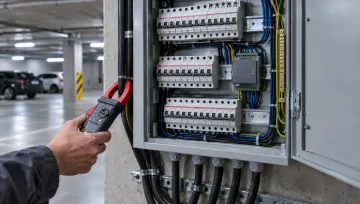
During the site assessment, an electrician inspects the garage, the cable route to the parking spaces and the distribution board that would feed the shared line. The approved power is checked as well: unless the grid connection approval states otherwise, a three-phase connection is considered to have 17,25 kW (3×25 A).
Before the assessment, have photos of the distribution board and the latest electricity bill for the common areas ready. Based on these, a rough estimate can be given even before the site visit.
What matters for charging is how much of that power is spare at night. If all 17,25 kW is available, eight hours gives 138 kWh — about 27 kWh for each of five cars, or 130–150 km. Load management distributes the available power among the chargers so that total consumption doesn’t exceed the approved power.
A power increase is requested from EDS, the grid operator, and its cost is set by the EDS price list; with load management, it often isn’t needed. The math for larger garages is in the guide on how much power a garage needs.
Step 3: the quote and templates for the assembly
After the assessment come the quote with the price for each participant, our technical description of the installation and the templates for the residents’ assembly: a draft decision, the agenda item wording and answers to residents’ questions, plus a step-by-step checklist. The initiator or the building manager fills in the templates.
The quote should state clearly what each participant gets, what it costs and how electricity is metered and billed. Pay particular attention to what is not included:
- A power increase or new grid connection from EDS.
- Excavation and asphalt work, if the parking area is in the courtyard.
- Fees of the authorities, where required — the property owner files the application; we provide the technical description of the works
- Repairs to the existing wiring, if the site assessment finds it faulty.
The draft decision should answer the questions residents will raise at the meeting:
- Who is taking part and what each spot costs, including its portion of the shared line.
- How electricity is metered and how participants pay it back to the building.
- How other residents can join later, and on what terms.
- Who maintains the equipment and who faults are reported to.
- What happens to a spot when a participant sells their apartment or moves out.
Schedule the meeting only once the quote is ready, so residents vote on a concrete proposal with prices.
Step 4: the residents’ assembly decides
The shared line runs through the building’s common areas. Under the Law on Housing and Building Maintenance (Art. 12), the owner of an apartment or another separate unit may make changes to the common areas only with authorization. That is why the residents’ assembly decides on chargers.
The law (Art. 44) provides for two kinds of majority:
- A simple majority of the votes of members present who are entitled to vote on the matter — unless the law provides otherwise.
- Two-thirds of the total number of votes — for disposing of the building’s common areas, including leasing them out, for entrusting management to a professional manager and for taking out a loan.
The assembly can make decisions if a majority of the total number of votes is present; at a repeat meeting, 1/3 of the total number of votes is enough (Art. 45).
Which majority the shared line needs depends on exactly what is being decided. That’s why the building manager, and a lawyer if needed, should review the draft decision before the meeting. The manager then puts the item on the agenda and signs the decision.
Step 5: installation and monthly statements
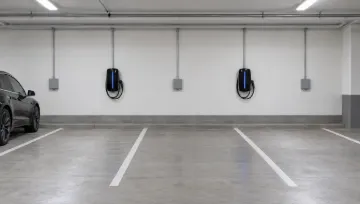
First the sub-panel with protective devices and load management goes in, then the shared line along the parking spaces, and finally the participants’ chargers. Installing one spot takes one working day, and a licensed company then inspects the whole installation.
Each participant chooses a reinforced socket or an 11 kW wallbox. The reinforced socket adds up to about 180 km overnight, while the 11 kW wallbox fully charges even an empty car in one night.
Participants pay for the electricity their chargers use by their own MID meters, at the price on the building’s bill and with no markup.
With a subscription, a statement arrives once a month for each spot separately. A resident who joins later covers the cost of their own spot and the connection to the existing line.
Participants pay, not the building
The price for a participant has two parts: their own charging spot and a portion of the shared line. The whole project costs the building nothing.
An example from the calculator for a garage with up to 30 spaces and the distribution board 10–30 m away, per participant, including VAT:
The exact amount depends on the garage and is set at the site assessment. You can work out an estimated price for your building in the charger price calculator.
If, on a larger project, the building does decide to fund part of the work jointly, there are also loans for residents’ associations. Borrowing requires a decision by 2/3 of the total number of votes, and the bank will ask for a registered residents’ association, a building manager and a bank account.
The whole process takes 4–10 weeks
Including the assembly decision, the whole process takes 4–10 weeks. Scheduling the meeting and voting take up most of the time; the installation itself is the shortest part of the job. If a power increase is needed, the timeline also depends on EDS.
Sources
- Law on Housing and Building Maintenance (Official Gazette of RS 104/2016 and 9/2020), Arts. 12, 44 and 45
- Stanovanje.gov.rs: Q&A on the majorities required for assembly decisions
- Regulation on the Conditions of Electricity Delivery and Supply (Official Gazette of RS 84/2023, 58/2025, 67/2025, 48/2026 and 81/2026), Arts. 17–20
- AERS (Energy Agency of Serbia): grid connection costs
- Biznis.rs: about 7.200 electric cars in Serbia (August 17, 2026)
- Auto-moto revija: new vehicle sales in the first half of 2026
This guide was written with the help of AI tools based on the sources listed and was last checked on September 30, 2026. If you spot an error or have newer data, let us know at hello@evolako.com — we publish corrections with a date.
Evolako for apartment buildings
Evolako assesses the garage and provides templates for the building assembly, along with a technical description of the installation. It installs chargers with MID meters and, with the optional subscription, keeps a monthly statement for every spot. An on-site assessment costs 2.990 RSD and is credited toward the installation.
Related guides

Home charging for apartment residents — installation, MID meter and billing down to the dinar.
The iPhone and Android app is coming soon.
Let me know when it’s out →