How much power a garage needs for 10, 20 or 50 chargers
Based on EU practice, a garage with 10 chargers and load management needs about 15–47 kW, with 20 chargers about 30–87 kW and with 50 about 75–207 kW. The lower figure is the minimum of 1,5 kW per car if they all charge on the same night. The upper one is a guideline for the cable route and sub-panel; the approved power and the site assessment show how much power is actually available at night.
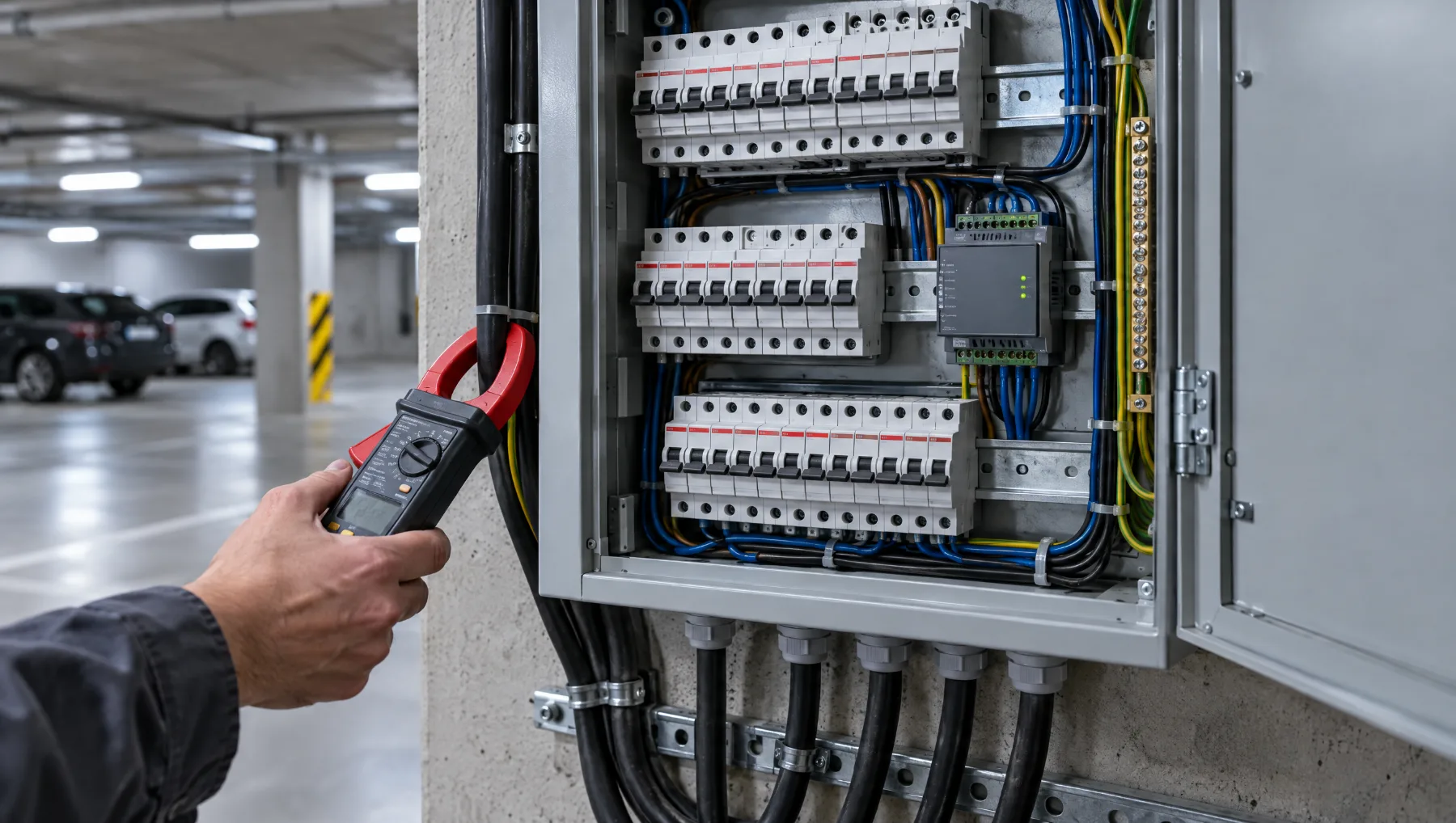
If you simply add up the power, 10 chargers at 11 kW call for 110 kW. A connection that size is rarely needed: cars don’t arrive at the same time, usually aren’t empty and don’t all charge to full. How chargers are planned in company garages and office buildings is described on the page about chargers for parking garages.
Chargers don’t all run at full power at the same time
A dynamic load management (DLM) system measures consumption at the grid connection and distributes the available power among the chargers. When the building uses more, the chargers slow down; when consumption drops, they speed up.
That’s why EU practice, with load management, uses a simultaneity factor of 0,1–0,3. You then plan for 10–30% of the chargers’ combined power: for 10 chargers at 11 kW, or 110 kW, that’s 11–33 kW.
A factor of 0,1 means planning power as if one charger in ten runs at full capacity at any given time; 0,3 means roughly one in three. Which value fits your garage depends on how many cars charge each night and how long they stay parked.
Charger power depends on how long the car stays parked
Power in kW tells you how fast a car charges; energy in kWh tells you how much electricity went into the battery. An 11 kW charger adds about 60 km per hour of charging.
For overnight or a workday, an 11 kW charger is enough. A 22 kW charger only makes sense where cars stay for 1–3 hours and the car itself accepts 22 kW on AC.
For long stays — residents, employees or rental garages, for example — a 2,3–3,7 kW reinforced socket is also enough. It adds up to about 180 km overnight and needs less power per spot from the garage.
A garage with different kinds of users can combine both: sockets for spots where cars stay a long time and 11 kW chargers for the rest.
The overnight math: 17,25 kW for five cars
Approved power is the maximum power a building may draw from the grid, as set in its grid connection approval. When the approval doesn’t say otherwise, a three-phase connection is considered to have 17,25 kW (3×25 A); the minimum approved power for a three-phase connection is 11,04 kW (3×16 A).
If 17,25 kW is available for charging at night, eight hours gives 138 kWh. Split among five cars, that’s about 27 kWh per car, or 130–150 km of driving.
Based on EU practice, the minimum is about 1,5 kW per charging car: over seven hours of overnight charging, that’s about 50 km. For comparison, a 43,5 kW connection can supply 12 spots at 3,6 kW each at the same time.
Estimated power for 10, 20 and 50 spots
In the EU, cable routes and sub-panels are sized with a rule of thumb: 11 kW for the first spot and about 4 kW for each additional one, with load management. That’s the upper guideline; the minimum comes from the 1,5 kW-per-car rule.
The table doesn’t tell you what grid connection to apply for; it’s a guideline for planning the cable route and sub-panel. The minimum assumes that all cars charge on the same night.
For a garage with 20 chargers at 11 kW, the three rules give this picture:
- Minimum, if all 20 cars charge on the same night: about 30 kW (20 × 1,5 kW).
- With a simultaneity factor of 0,1–0,3: about 22–66 kW; the lower value applies when only some of the cars charge each night.
- Upper guideline for the cable route and sub-panel: about 87 kW.
Where your garage falls in that range depends on the approved power and the number of cars that actually charge each night.
Load management means more spots on the same connection
Without load management, every new charger needs more power. With it, the chargers share what the building already has, so more spots can run on the same connection without overloading it.
Load management also works when other loads share the connection, such as lighting, ventilation and barrier gates: the chargers get whatever power is left over.
That’s why a cable route with junction boxes can run along all the spaces, with chargers added as the number of electric cars grows. A space prepared in advance, with a cable route and junction box, is connected later without new work across the garage.
When a garage has different users, each charger has its own MID-certified meter. Consumption is then split by spot rather than into equal shares, and each user is billed only for what they used.
A power increase is only needed when there isn’t enough even at night
Increasing the approved power makes sense when, even with load management, there isn’t enough at night for the cars that charge. For example, if a garage has 11,04 kW and 20 cars charge every night, that’s below the 30 kW minimum (20 × 1,5 kW).
Power is increased on the existing connection, or a new connection is requested for the garage. You can’t get more power by swapping fuses or the current limiter: a change in approved power has to be granted by EDS, the grid operator, on application.
The application to change approved power is filed with EDS. Under the Energy Law, the deadline for deciding on the application is 15 days; in practice, with the contract and the works, the whole process takes longer.
The connection cost is set by EDS, the grid operator, based on the AERS methodology and its price list. The property owner files the request with EDS, and in a charger quote this cost should appear as a separate line item, with no markup from the installer.
The real figure comes from the approved power and a site assessment
The site assessment checks the approved power, the building’s daytime and nighttime consumption, the distance from the distribution board and how many spots are needed now versus later.
In a new build, the number of charging spots isn’t just a question of power. Under the Law on Planning and Construction (Art. 31), the planning document also sets a mandatory minimum number of charging spots.
Before the assessment, have your latest electricity bill and photos of the distribution board ready. Based on these, a rough estimate can be given even before the site visit.
An example from the calculator: a garage with 10 chargers at 11 kW and the distribution board 30–60 m away costs about 1.458.000–1.873.000 RSD including VAT. With another 20 spaces prepared for later, the price is about 1.848.000–2.233.000 RSD.
A power increase from EDS is not included in these figures. You can work out an estimated price for your garage in the charger price calculator.
Sources
- Regulation on the Conditions of Electricity Delivery and Supply (Official Gazette of RS 84/2023, 58/2025, 67/2025, 48/2026 and 81/2026), Arts. 17–20
- Elektrodistribucija Srbije (EDS): the connection procedure outside the unified permit procedure and changes in power
- AERS (Energy Agency of Serbia): grid connection costs
- Law on Planning and Construction, Art. 31
This guide was written with the help of AI tools based on the sources listed and was last checked on September 30, 2026. If you spot an error or have newer data, let us know at hello@evolako.com — we publish corrections with a date.
Evolako for garages and parking lots
At the assessment Evolako checks the approved power and the building's consumption, then installs chargers with power management and a MID meter at every spot. With the optional subscription you get a monthly statement per spot. An on-site assessment costs 2.990 RSD and is credited toward the installation.
Related guides

Home charging for apartment residents — installation, MID meter and billing down to the dinar.
The iPhone and Android app is coming soon.
Let me know when it’s out →