Chargers for a hotel: how many spots, what power and how electricity costs are calculated
A sensible start for a hotel is 2–4 spots with 11 kW chargers and a cable route ready for more: guests arrive in the evening and leave in the morning with a full battery. Electricity is calculated at the price on the hotel’s bill, and a MID-certified meter at each spot shows the kWh used.
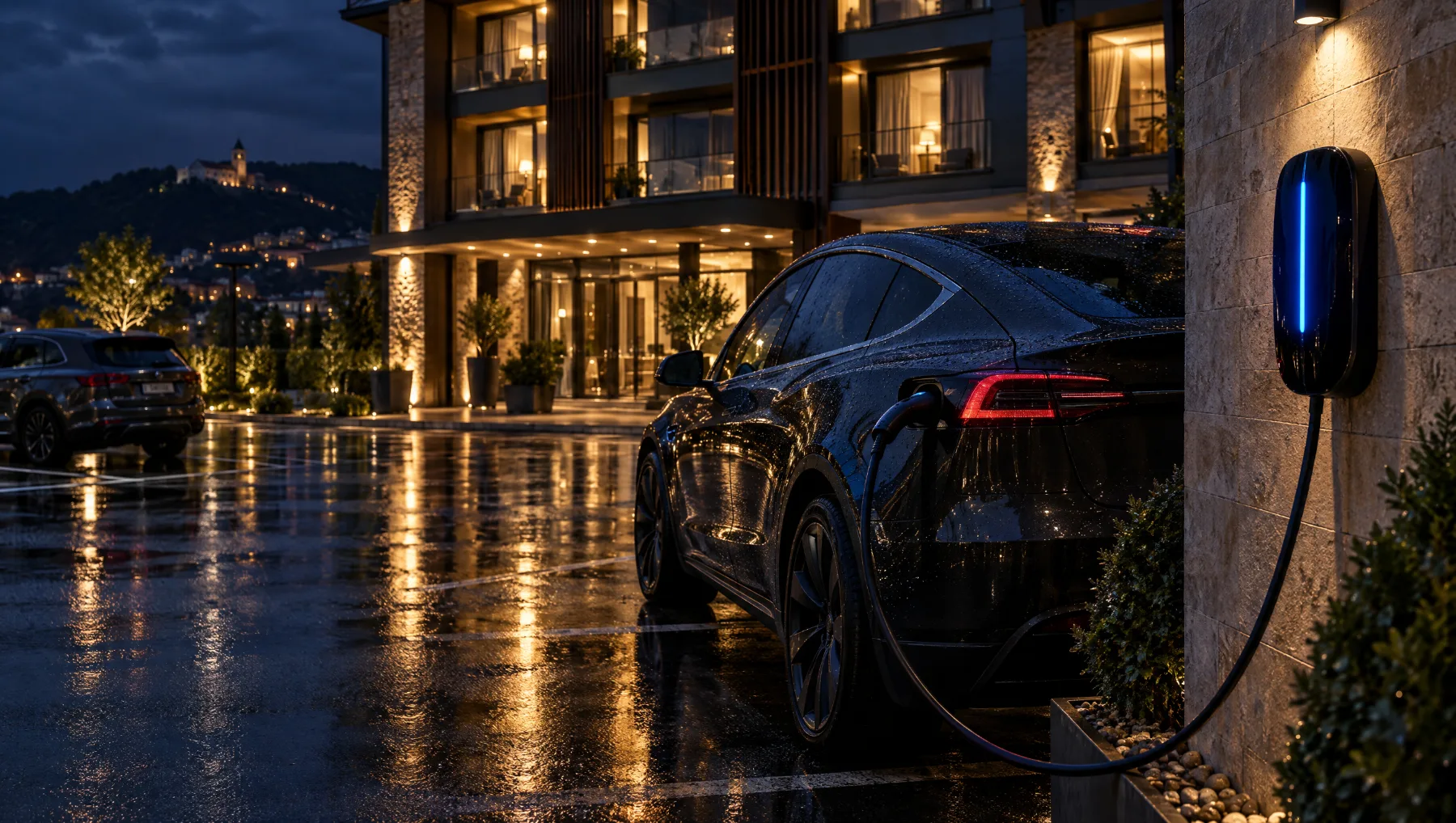
About 7.200 electric cars are registered in Serbia, and sales of new ones in the first half of 2026 were more than three times higher than a year earlier. Travel sites already group hotels with chargers into separate lists. The offer for hotels and vacation rentals, with price examples, is described on the page about chargers for hotels.
Start with 2–4 spots and prepare the cable route for more
The number of spots depends on how many guests arrive by electric car and how long they stay, and at first you can’t know that precisely. A practical start is 2–4 spots: a guest who books a room can count on a charger, and the hotel doesn’t invest in spots that sit empty.
Guest inquiries are a good indicator: if people ask about a charger when booking, the demand is already there. Keep track of these inquiries so you have a basis for deciding how many spots you need.
It pays to prepare the cable route and sub-panel for more spots from the start. When demand grows, a new charger is added to the existing route, with no new work in the garage.
Choose the first spots as close to the distribution board as possible, since a shorter cable route means a lower price. Mark the charging spots and reserve them for cars that are charging, so other guests don’t take them.
If the hotel is still being built, the number of spots isn’t only your decision. Under the 2023 amendments to the Law on Planning and Construction (Art. 31), the planning document must also set a mandatory minimum number of charging spots. The exact number is in the planning document and the location conditions for your lot.
For vacation rentals and smaller villas, 1–2 spots are enough to start, with a reinforced socket (up to about 180 km overnight) or an 11 kW wallbox.
For overnight guests, 11 kW is enough
An 11 kW wallbox adds about 60 km for every hour of charging and fully charges even an empty car in one night. So a more powerful charger gives an overnight guest nothing extra.
A 22 kW charger makes sense where cars are parked for 1–3 hours, for example for people visiting the restaurant or a conference hall. The car itself must also accept 22 kW on AC, which is listed in its specifications.
A fast DC charger is a separate project with a new grid connection. It makes sense where travelers stop only briefly, for example along a highway, and an overnight guest doesn’t need one.
Chargers use only the hotel’s spare power
A hotel already uses electricity for its kitchen, air conditioning and elevators, so the chargers must not interfere with the rest of the building’s equipment. Load management measures the building’s total consumption and turns the chargers down when everything else runs at full capacity, so the total stays within the approved power.
At night, when the kitchen and function rooms are idle, the chargers get more power. Based on EU practice, the upper guideline for four spots with load management is about 23 kW: 11 kW for the first spot and about 4 kW for each additional one.
The site assessment shows how much of that the hotel has to spare by checking the approved power and nighttime consumption. If there still isn’t enough power, an increase is requested from EDS, the grid operator.
The cost of the increase is set by the EDS price list; for detailed power calculations, see the guide on how much power a garage needs.
Hotels in Serbia offer charging in three ways
Practice varies from property to property:
- According to the Zlatibor Tourist Organization’s list, some hotels offer charging at no extra charge, but only to guests.
- Other hotels on the same list charge for it together with parking — 200 RSD per hour, 990 or 2.000 RSD per day — or as a separate service.
- According to Tesla’s map (September 2026), Tesla Destination chargers in Serbia are at four locations, all of them places to stay: Crowne Plaza, Tesla Smart Stay and Square Nine in Belgrade, plus Vila Đokić on Zlatibor.
Three models emerge from this: charging at no extra charge as a guest amenity; charging included in the price of parking or the room; and charging billed separately. A charger can be open to everyone or to guests only, for example with a card the guest gets at the front desk.
Novi Sad has also planned for payment through parking: at city parking lots with 11 kW chargers, the price is 500 RSD per hour, parking included.
Choosing a model is the hotel’s business decision. Before you introduce a separate charge, check with your accountant and lawyer how it should be recorded.
If you include charging in the price of parking or the room, the MID meter shows what it actually costs you, so you can set the price based on measured consumption rather than guesswork.
Once the charger is up and running, list it in the hotel’s description on booking sites and on your own website: power, connector type (Type 2), terms of use and the price, if you charge for it.
Electricity is calculated at the price on the hotel’s bill
The chargers draw power through the hotel’s grid connection, so the electricity is calculated at the price on your bill. Household tariffs, which often appear in charging cost estimates, don’t apply to a hotel.
The MID meter at each spot measures how many kWh have gone through that charger. Multiply the kWh used by the price on your bill and you get the exact charging cost for each spot, month by month.
These readings are turned into a monthly statement per spot. It serves your accounting and, if guests pay for charging, also as the basis for billing them.
Charger installation needs a decision approving the works
Under the current rulebook on special types of works (Official Gazette RS 87/2023 and amendments), installing chargers requires a decision approving the works under Art. 145 of the Law on Planning and Construction. At the assessment we tell you exactly what applies to your property; we provide the technical description of the works and the as-built documentation, and the property owner obtains the approval, if one is needed.
Electrical installations in workplaces are inspected periodically (every three years), and the charger becomes part of that inspection. So when you review a quote, also check who maintains the chargers, how long the warranty lasts and how quickly a reported fault gets a response.
Estimated prices for 2, 4 and 6 spots
Examples from the calculator for 11 kW wallboxes, including VAT:
- Two spots next to the distribution board: about 220.000–244.000 RSD.
- Four spots in a garage, with the distribution board 10–30 m away: about 656.000–872.000 RSD, or about 164.000–218.000 RSD per spot.
- Six spots in an outdoor parking lot, on pedestals, with the distribution board 10–30 m away: about 1.079.000–1.350.000 RSD, excluding excavation and asphalt work.
A power increase from EDS, if needed, is not included. You can work out an estimated price for your property in the charger price calculator.
Sources
- Travelmyth: hotels with EV charging in Serbia
- Zlatibor Tourist Organization: EV chargers on Zlatibor
- Tesla: Destination charger locations in Serbia
- B92: chargers at Novi Sad parking lots and the hourly price of parking with charging (February 6, 2026)
- Rulebook on Special Types of Structures and Special Types of Works (Official Gazette of RS 87/2023, 16/2024 and 16/2026), Art. 4, item 35
- Law on Planning and Construction, Arts. 31 and 145
- Law Amending the Law on Planning and Construction (Official Gazette of RS 62/2023)
- Biznis.rs: about 7.200 electric cars in Serbia (August 17, 2026)
- Auto-moto revija: new vehicle sales in the first half of 2026
This guide was written with the help of AI tools based on the sources listed and was last checked on September 30, 2026. If you spot an error or have newer data, let us know at hello@evolako.com — we publish corrections with a date.
Evolako for hotels and vacation rentals
Evolako installs 11 kW chargers with a MID meter at every spot and power management, provides a technical description of the work and suggests in the quote how to charge guests. An on-site assessment costs 2.990 RSD and is credited toward the installation.
Related guides

Home charging for apartment residents — installation, MID meter and billing down to the dinar.
The iPhone and Android app is coming soon.
Let me know when it’s out →