A rental garage with an EV charger: owner consent, the MID meter and electricity billed with rent
A garage or garage parking space you rent out can usually be fitted with a charger on the existing meter. A MID-certified meter measures what the charger uses, and the tenant pays you for that electricity with the rent, at the price on your bill.
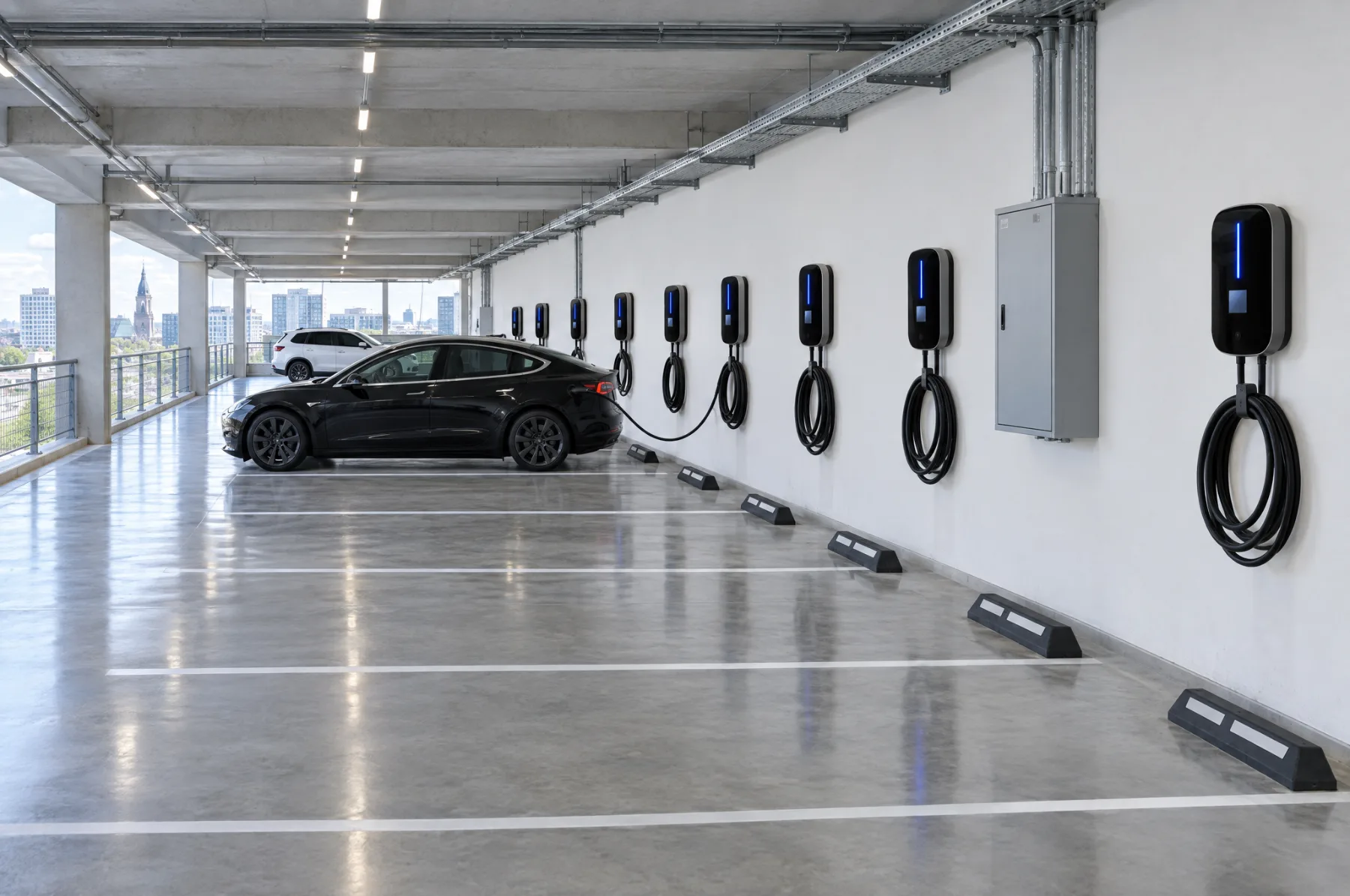
This guide is for individuals, companies and developers who rent out a garage, a garage parking space or a garage box. You can work out an estimated price for your layout in the charger price calculator for garages.
Approvals: your own unit, the common areas and the tenant
A garage, a garage parking space and a garage box can each be a separate unit of a building (Art. 4 of the Law on Housing and Building Maintenance). Within their own unit, the owner exercises ownership rights exclusively, unless the law provides otherwise (Art. 12, para. 1, item 1).
The cable from the meter to the garage usually runs through the building’s common areas. The owner may carry out work that affects the common areas only with the required authorization (Art. 12, para. 1, item 3).
Placing items in the common areas is decided by the residents’ assembly, by a simple majority of the votes of those present (Art. 42, para. 1, item 16 and Art. 44). A quorum is a majority of all votes, and one third at a reconvened session (Art. 45). An owner who votes in writing or electronically counts as present (Art. 44, para. 4).
If a garage or garage parking space is your only unit in the building, you vote only on decisions about the part of the building where it is located (Art. 43, para. 3). How the building manager runs the process from the first sign-ups to the decision is described in the guide chargers in an apartment building garage: a 5-step plan.
The simplest case is a garage or garage box with its own meter and distribution board: the charger connects to the garage’s own wiring. For a parking space in a shared garage, the wall or pillar for the charger is usually a common area, so the assembly decides on that as well.
The meter and approved power: where the charger gets its electricity
The charger connects either to the garage’s meter or to the meter of your apartment or business premises. That determines whose name the bill is in and which bill you take the price from for the statement.
Avoid the common-area meter: its bill is paid by the residents’ association, so all the owners would be paying for the tenant’s electricity until it is settled. If there is no other option, agree on the billing model with the building manager and the assembly first.
You can find the approved power on your electricity bill. If that figure is missing, a three-phase connection with direct metering is deemed to have an approved power of 17,25 kW. The lowest approved power for a three-phase connection is 11,04 kW, with a 16 A limiter (Arts. 18 and 19 of the Regulation on the Conditions of Electricity Delivery and Supply).
START is a dedicated line with a reinforced socket that charges at 2,3–3,7 kW, which also works on a smaller connection. An 11 kW wallbox needs a three-phase connection and won’t run at full power on a smaller one: we set the maximum charging current to the power left after your other consumption.
If there isn’t enough power, you submit the power increase request to EDS (the grid operator), and we list the cost as a separate item in the quote, with no markup from us. For a garage with several spots, the math is in the guide how much power a garage needs for 10, 20 or 50 chargers.
The MID meter: the same kWh figure for you and the tenant
When you charge the tenant for electricity, the charger’s consumption has to be measured separately from the other devices on the same meter. That’s why the charger comes with a MID meter, which measures the kWh used at that spot. Take a photo of the meter reading at every statement and at the end of the lease, so both sides have the same figure.
MID stands for the EU Measuring Instruments Directive 2014/32/EU, and in Serbia the same area is covered by the Rulebook on Measuring Instruments (Official Gazette of RS 3/2018), which is aligned with that directive. Check with the Directorate of Measures and Precious Metals whether a meter you use to bill another party is subject to verification.
The per-spot subscription is optional, with no contractual commitment. It gives you a monthly statement based on the MID meter in PDF and CSV, plus a yearly check of the wiring and equipment. The kit also works without a subscription; you then read the meter yourself.
Electricity with the rent: no markup, but not without VAT
The clearest model is rent plus a charge for the metered kWh at the price on your electricity bill. No markup means you charge the tenant only the cost of the electricity, with no profit on the kWh. Passing the cost on like this is called cost pass-through (re-invoicing).
Agree in advance on how the kWh price is worked out, for example as the electricity amount on the bill divided by that month’s consumption in kWh. Such an average price already includes the higher and lower tariff and the consumption zone, and both sides can check it against the bill.
The Ministry of Finance treats electricity costs that a VAT-registered landlord passes on to a tenant as part of the VAT base. This is set out in opinions No. 413-00-477/2009-04 of March 3, 2009 and No. 430-00-503/2018-04 of October 15, 2018.
Electronic invoices via SEF are mandatory between VAT payers and toward the public sector, and they are not issued to individuals. Before the first statement, ask your accountant:
- whether you are a VAT payer and how to show the electricity alongside the rent;
- whether charging a tenant who is an individual requires a fiscal receipt;
- if you rent out the garage as an individual, whether the electricity you collect counts as rental income;
- how the electricity is treated when the garage is on your apartment’s meter.
Agreement with the tenant: what to put in writing before the first statement
If the garage is already rented out, agree on the installation date with the tenant beforehand. Put the rules of use and billing in writing before the first month of charging, so both sides know what they are paying for:
- the opening MID meter reading on the handover date, with a photo;
- how the kWh price is worked out and by what date the electricity is paid with the rent;
- who owns the charger and what happens to it when the lease ends;
- whom the tenant reports a fault to and who pays for the repair;
- that the tenant does not use extension cords or power strips and does not change the charger or wiring settings.
This is a list of topics, not a contract template. Check with your lawyer how to put them into the lease or an addendum. Ask your insurer whether the garage policy also covers the charger.
Permit for the work and fire safety
Under the Rulebook on Special Types of Structures and Works (Official Gazette of RS 87/2023), installing a charger is a type of work for which a decision approving the works is issued. The decision is issued under Art. 145 of the Law on Planning and Construction.
The approval, where required, is obtained by the property owner from the competent authority. We provide the technical description of the work and the as-built documentation.
Since April 19, 2024, the Rulebook on Technical Standards for Fire Safety of Garages (Official Gazette of RS 31/2024 and 59/2025) has been in force. It provides that a garage may include an area for charging electric vehicles (Art. 3, para. 2).
The rulebook does not prohibit charging and does not set specific technical requirements for chargers. It does not require existing garages to be retrofitted, but a reconstruction must not reduce fire safety (Arts. 1 and 4). Escape routes must stay clear (Art. 20), and the electrical side is covered by general regulations and standards, including SRPS HD 60364-7-722 and SRPS EN IEC 61851-1.
Packages, timelines and the order of steps
Evolako installs the charger with a MID meter and provides templates for the residents’ assembly: a draft decision and an agenda item. The assembly session, the arrangements with the building manager and the requests to EDS are handled by you or the building manager.
Both prices include basic installation next to the distribution board: a dedicated line with up to 2 m of cable, RCD protection and a circuit breaker. A cable to the spot, a cable route, a pass-through in a wall, a new board or a power increase are priced at the site assessment and listed in the quote.
The on-site assessment costs 2.990 RSD and is credited toward the installation price. You can also get a rough estimate by message, based on photos of the distribution board, the garage and an electricity bill.
Installing one spot takes one working day. Without an assembly decision, the whole process usually takes 1–2 weeks, and with one, 4–10 weeks; a power increase and a permit decision, if needed, can extend it. The order of steps:
- find the meter and the approved power on your electricity bill;
- check whether the cable or the charger affects the common areas and, if so, start the assembly decision through the building manager;
- agree on the installation date and the billing rules with the tenant in writing;
- book a site assessment and choose START or WALLBOX.
Sources
- Law on Housing and Building Maintenance (Official Gazette of RS 104/2016 and 9/2020), Arts. 4, 12 and 42–45
- Regulation on the Conditions of Electricity Delivery and Supply (Official Gazette of RS 84/2023, 58/2025, 67/2025, 48/2026 and 81/2026), Arts. 18 and 19
- Rulebook on Measuring Instruments (Official Gazette of RS 3/2018), Art. 24
- Law on Value Added Tax
- Law on Planning and Construction, Art. 145
- Rulebook on Technical Standards for Fire Safety of Garages (Official Gazette of RS 31/2024, published April 11, 2024)
This guide was written with the help of AI tools based on the sources listed and was last checked on October 22, 2026. If you spot an error or have newer data, let us know at hello@evolako.com — we publish corrections with a date.
Evolako for garages and parking lots
A MID meter at every spot, load management and a monthly statement per user with a subscription, at no markup. The page has price examples for garages and parking lots.
Related guides
Home charging for apartment residents — installation, MID meter and billing down to the dinar.
The iPhone and Android app is coming soon.
Let me know when it’s out →