11 or 22 kW: how much power a home charger needs
For charging at home an 11 kW charger is enough, and often a smaller one. A 22 kW charger needs 32 A per phase, more than an apartment’s standard power, and many cars accept at most 11 kW on alternating current.
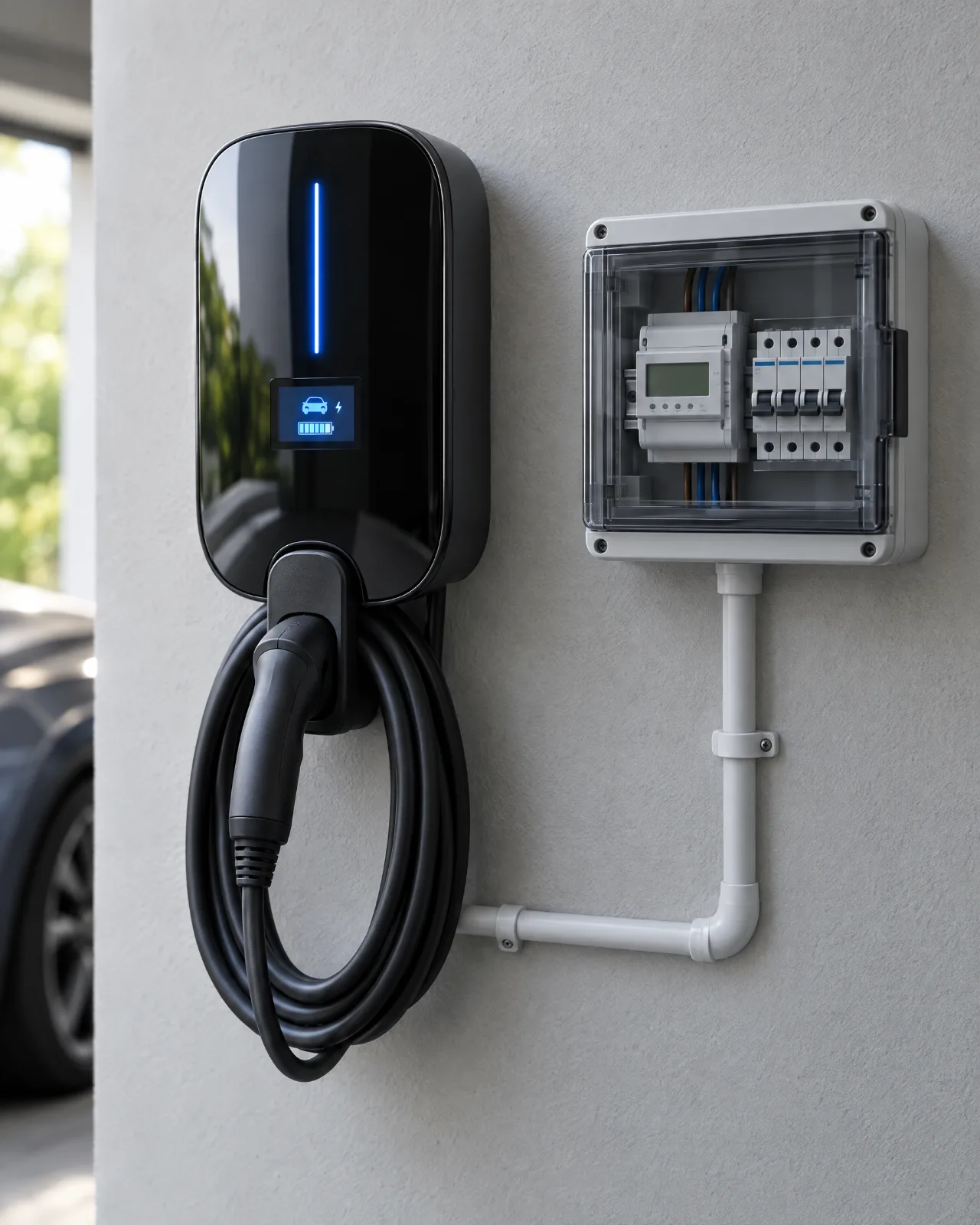
The power your car actually gets depends on three things: the charger built into the car, the approved power of your apartment or house, and how much you drive. The weakest of the three sets the speed.
Below are the numbers and a check you can do yourself. If you want to know what is possible in your case, check your garage.
The charger built into the car sets the speed
A home charger supplies alternating current, and the charger built into the car converts it into direct current for the battery. The car takes at most what that on-board charger allows, even when the wallbox is stronger.
According to ADAC, a car needs to charge on three phases at 16 A per phase for 11 kW, and on three phases at 32 A per phase for 22 kW. You will find this in your car’s manual or technical data.
Three examples from the EV Database show how much cars differ:
- The VW ID.3 Pro accepts at most 11 kW and fills its 59 kWh battery on an 11 kW wallbox in about 6.5 hours.
- The Renault Zoe ZE50 R135 accepts up to 22 kW and fills up on such a charger in about 3 hours.
- The Dacia Spring Electric 65 charges on a single phase only, up to 6.6 kW. On an 11 kW wallbox it gets 3.7 kW because it uses just one phase.
Among cars that accept 22 kW, ADAC lists, for example, models from Renault, BMW, Audi, Mercedes-Benz, Porsche and the Nissan Ariya. The same model sometimes comes in several versions, so check the data for your exact car.
For a car that charges on a single phase, the difference between an 11 kW wallbox and a reinforced socket disappears: both give about 3.7 kW. A car that accepts 22 kW, like the Zoe, charges at 11 kW on an 11 kW wallbox, which is enough for a night.
An apartment usually lacks the power for 22 kW
The approved power of a household is set by the Regulation on the conditions of electricity delivery and supply. For a three-phase connection it is 17.25 kW, or 3×25 A, and for a single-phase one it is 5.75 kW.
A 22 kW wallbox draws 32 A per phase, while the whole apartment on a standard connection may draw 25 A per phase. Such a charger cannot run at full power in an apartment even with everything else switched off, so the electrician sets it to a lower current.
An 11 kW wallbox draws 16 A per phase. On a 3×25 A connection the apartment is then left with 9 A per phase for the stove, the water heater and the rest. That is why the charger should have load management: it watches the apartment’s consumption and lowers the charging power when you switch on bigger appliances.
Some apartments have the minimum three-phase power of 11.04 kW, with a 16 A limiter. There an 11 kW wallbox works only with load management and usually gets less than full power at night.
For the full 22 kW the apartment would need a higher approved power from Elektrodistribucija Srbije. That means an application, costs set in the decision and an electrician’s work, and for home charging it rarely pays off.
Less than 11 kW is enough for one night
According to the EV Database, the VW ID.3 Pro uses about 16.2 kWh per 100 km. For 30 km a day that is about 5 kWh, and for 80 km about 13 kWh.
An 11 kW wallbox can deliver up to 88 kWh in 8 hours of the lower tariff, more than fits in the ID.3 battery. A 3.7 kW reinforced socket delivers about 30 kWh in the same 8 hours, which is up to about 180 km of range.
The difference between 11 and 22 kW only matters when the car is parked briefly and needs a lot of energy. At home the car usually stands all night, so 22 kW brings nothing you would notice in the morning.
When an 11 kW wallbox makes sense, and when 22 kW does
An 11 kW wallbox makes sense if you drive more per day than a reinforced socket can put back overnight, if your car charges on three phases or if you want a full car even after a short night.
It needs a three-phase connection up to the charging spot. If the apartment has a single-phase connection, an 11 kW wallbox cannot run at full power, while a reinforced socket works without any changes.
A 22 kW wallbox makes sense at a house with a bigger connection, for a car that accepts 22 kW and is often parked for only a few hours. In an apartment building this is rare.
What to check before you choose
- In the car’s manual: how many kW it accepts on alternating current and whether it charges on one phase or three.
- With Elektrodistribucija or in the connection decision: the approved power and whether the connection is single-phase or three-phase.
- How many kilometers you drive on a normal day and how many hours the car stands at home.
- Whether the charger has load management, so it does not trip the breakers when the stove or water heater is on.
- How far your parking spot is from the distribution board, because the new circuit depends on it.
Do not change the approved power yourself by replacing the main fuses or the limiter. Only Elektrodistribucija changes it, on request, and work in the distribution board is done by a licensed electrician.
For an apartment Evolako has two packages: START, a reinforced 2.3–3.7 kW socket with a MID meter, and WALLBOX, a three-phase 11 kW charger with an optional MID meter. What's included is on the page packages and prices.
Sources
- Regulation on the conditions of electricity delivery and supply, Art. 18 and 19 — approved power of a household
- ADAC — 11 or 22 kW wallbox, current per phase and cars that accept 22 kW
- EV Database — VW ID.3 Pro (2024–2026), charging and consumption
- EV Database — Renault Zoe ZE50 R135, charging up to 22 kW
- EV Database — Dacia Spring Electric 65, single-phase charging
This guide was written with the help of AI tools based on the sources listed and was last checked on October 1, 2026. If you spot an error or have newer data, let us know at hello@evolako.com — we publish corrections with a date.
Check which power suits your garage
Evolako START, a reinforced socket with a MID meter, costs 39.000 RSD with VAT, and WALLBOX 11 kW with a MID meter 104.000 RSD with VAT. An on-site assessment is 2.990 RSD and is credited toward the installation.
Read next
Home charging for apartment residents — installation, MID meter and billing down to the dinar.
The iPhone and Android app is coming soon.
Let me know when it’s out →