Charging your car from a Schuko socket: safety, speed and when it is enough
Yes, you can charge your car from a Schuko socket if it is in good condition, on its own circuit and with reduced current. It is slow: at 10 A you get about 13,5 km of range per hour, so an 8-hour night gives about 108 km before losses.
The portable cable that comes with your car, often called an emergency or granny cable, works with any Schuko socket. The real question is whether your socket and the line behind it can handle several hours of load without a break.
Below you will find the speed math, the signs that a socket is not fit for charging, and what a dedicated solution looks like. If you need a permanent charging spot, first see what is possible with your garage.
At 10 A the car gains about 13,5 km per hour
Power is voltage times current. At 230 V and 10 A that is about 2,3 kW, and at 8 A about 1,8 kW. A Schuko socket is rated for 16 A at most, but ADAC advises keeping the charging current at 10 A or lower.
You usually lower the current in the car settings or on the cable itself. With some manufacturers the cable offers steps of 6, 8, 10 and 12 A.
For consumption we assumed 17 kWh per 100 km. Popular compact models in the EV Database mostly use 15–17 kWh, and the average across all models there is 18,7 kWh. We count a night as 8 hours of charging.
At the night tariff of about 6 RSD per kWh in the blue zone, a night at 10 A uses about 18 kWh. That is about 110 RSD, plus losses.
The risk is heat at the contacts and in old wiring
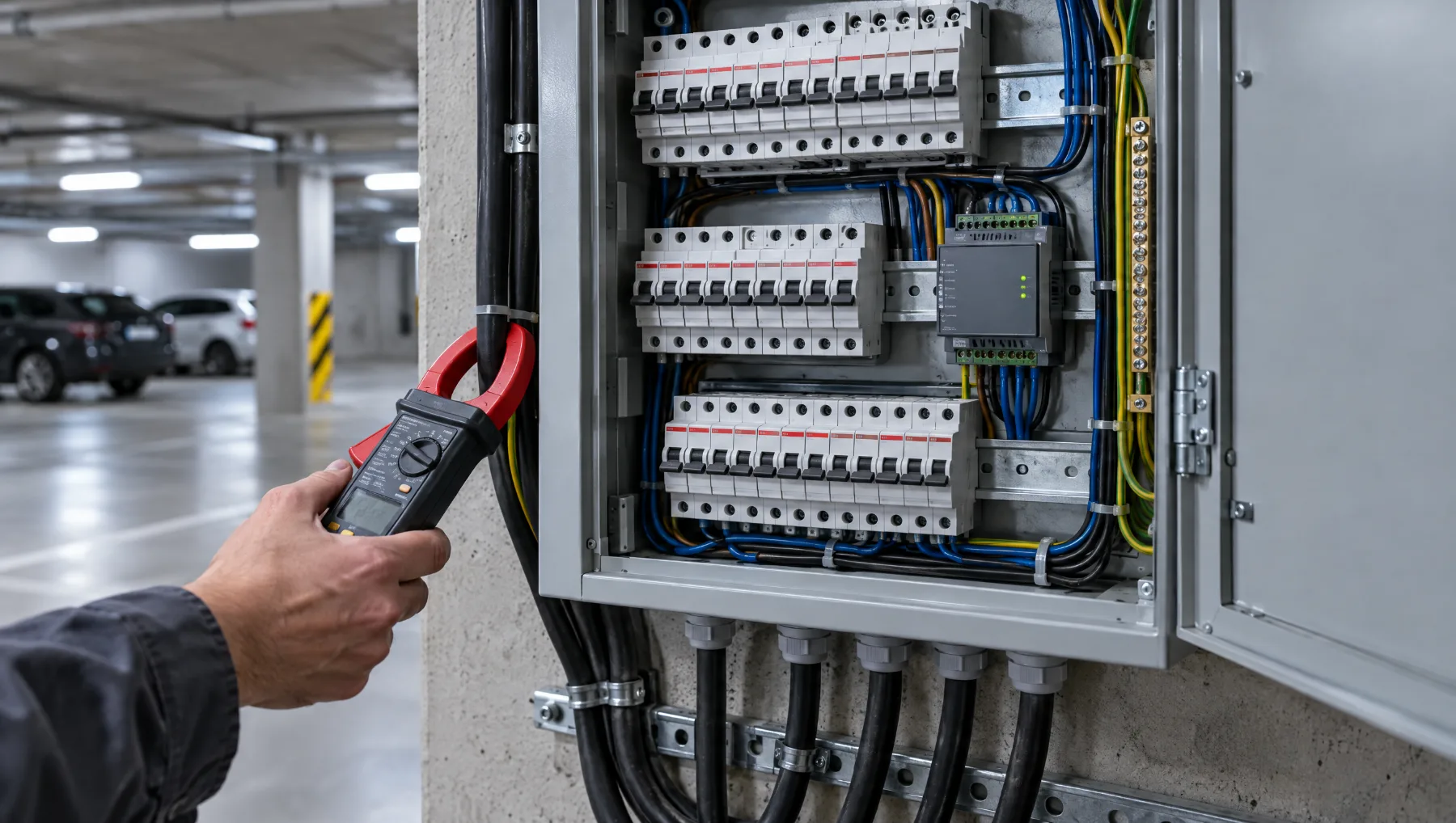
A Schuko socket is designed for household appliances and handles the full 16 A only for a limited time. Charging runs for hours without a break. ADAC warns that aged contacts, terminals in the line and poor installation raise resistance, which can cause overheating and fire.
Do not charge from the socket if you recognize at least one of these:
- The wiring is old, especially with aluminium conductors, which are more prone to heating and wear.
- The socket shares a circuit with a water heater, a washing machine or a space heater.
- The socket is loose, the plug does not sit firmly or the plastic has changed color.
- The breaker trips when several appliances run at the same time.
- There is no RCD protection in the distribution board.
Car manufacturers ask in their manuals that a licensed electrician check the socket if you have doubts about its condition. If the circuit does share other loads, they advise a lower charging current. If you smell burning or the socket is hot, stop charging.
On a socket you have not used for charging before, start with a lower current. After an hour or two of charging, check the plug by hand. If it feels warm, stay at the lower current or do not charge there.
The emergency cable goes straight into the wall socket
Car manufacturers’ manuals for the portable cable are clear on this. No extension cord, no splitter and no adapter. That also applies to cable reels and to power strips.
Every extra connection is one more place where a contact can heat up. ADAC names exactly contacts and terminals as the points where higher resistance builds up.
The socket should be close to your spot, so the cable does not cross a walkway or someone else’s parking space. If there is no such socket, the answer is a new dedicated circuit, not a longer cable.
For short trips and plug-in hybrids the speed is enough
If you drive 30–40 km a day, a night at 10 A covers it even after losses. At 8 A the margin is smaller, but it is still enough for that distance.
A plug-in hybrid has a smaller battery. The VW Golf eHybrid from 2020–2022 has 10,4 kWh of usable capacity and 71 km WLTP, so it fills up in one night at 10 A. According to ADAC, almost half of today’s plug-in hybrids exceed 100 km on electricity under WLTP, so they need more time.
Even when the speed is enough, ADAC sees the household socket only as an emergency option. For a weekend house, a visit or the time while you wait for a proper setup, a sound socket on its own circuit is a reasonable backup.
At 80 km a day or more, one night on a socket falls short
If you drive 80–100 km a day, a night at 10 A barely covers it once losses are counted. After a long trip you need several nights to refill the battery.
A large battery takes a very long time this way. VDE states that a nearly empty 60 kWh battery takes more than a day to charge from a household socket.
Daily charging needs a dedicated circuit
Standards for charging installations, for example the German DIN VDE 0100-722, require a separate circuit for each charging point. That circuit has its own overcurrent protection and a 30 mA RCD that also responds to DC fault current.
In practice this means a dedicated circuit from the distribution board to your spot, with its own breaker and RCD. At the end of the line goes a reinforced socket built for long charging, or a wallbox. A three-phase 11 kW wallbox gives more power than any socket can, if your car supports three-phase charging.
In a shared garage there is also the question of the bill. A garage socket is usually on the building’s common meter, so all residents pay for your charging. That quickly becomes a topic at the residents’ assembly.
In a building you also need to check the approved power, because a new circuit must not overload the connection. A MID meter at your spot measures exactly how much your car used, so the account with the building or the neighbors stays clean.
One such option is Evolako START, a reinforced socket with a MID meter for charging at 2,3–3,7 kW, and you can see all kits on the page kits and prices.
Sources
- VDE — FAQ on charging electric cars
- ADAC — charging an electric car at home, on a wallbox and at public stations
- ADAC — study of charging losses at a socket and a wallbox
- ADAC — overview of plug-in hybrids, ranges and consumption
- ADAC — technical data for the VW Golf 1.4 eHybrid (2020–2022)
- Kia — EV6 manual, precautions for the portable charger
- Hyundai — owner’s manual, using the portable charger
- Voltimum — what DIN VDE 0100-722 requires for charging installations
- EV Database — energy consumption of electric cars
- Saveti.rs — how dangerous old electrical wiring really is
This guide was written with the help of AI tools based on the sources listed and was last checked on September 30, 2026. If you spot an error or have newer data, let us know at hello@evolako.com — we publish corrections with a date.
Charge at a spot built for it
Evolako START is a reinforced socket with a MID meter, 2.3–3.7 kW and up to about 180 km in one night, for 39.000 RSD with VAT. An on-site assessment is 2.990 RSD and is credited toward the installation.
Read next

Home charging for apartment residents — installation, MID meter and billing down to the dinar.
The iPhone and Android app is coming soon.
Let me know when it’s out →